
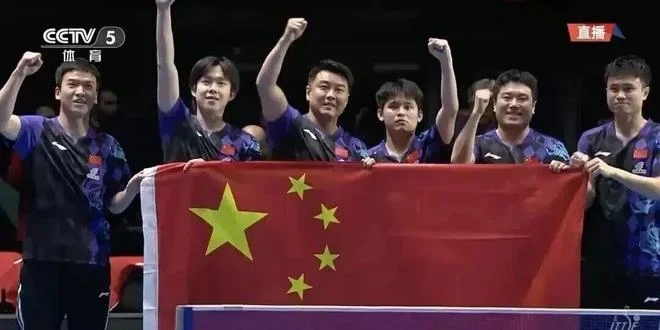
China’s men’s table tennis team delivered a dominant 3-0 victory over Japan in the final of the London World Championships, securing their 12th straight title and 24th overall Swaythling Cup triumph.
Despite extensive preparations by Japan, they were whitewashed, with the scoreline reflecting a chasm that effort alone could not bridge.
In the opening match, Liang Jingkun faced Tomokazu Harimoto. After falling two sets behind and trailing 3-8 in the decider, Liang mounted an incredible comeback, winning eight consecutive points to take the match 3-2. Remarkably, this was his second reverse sweep within 24 hours, having pulled off a similar turnaround against a French opponent in the semifinals. Fans dubbed him the “comeback king,” but the description barely captures his nerve — it was as if he danced on the edge of a cliff, then waved to his rivals.
For Harimoto, the collapse was devastating. From a 2-0 lead to defeat, the psychological blow was far worse than a straight 3-0 loss. The problem, however, runs deeper than tactics or technique — it’s the collective resilience ingrained in the Chinese system, a legacy built over generations.
The final also fell on Wang Chuqin’s 26th birthday. He dropped the first game but stormed back to win three straight, including an 11-2 third set. With a perfect 10-0 record and MVP honors, he shouldered the top spot, faced tough opponents, and made zero mistakes. After the match, the media sang him “Happy Birthday,” but more fitting was his own gift — a triumph forged through grit. When he embraced Ma Long afterward, it wasn’t for show; it symbolized the torch passing. Ma Long handed over the burden, and Wang caught it, holding it firmly.
Lin Shide, just 19 years old and playing in his first world championship final, held his nerve to defeat Tomokazu’s compatriot Shunsuke Togami 3-1, sealing the overall win. His performances signaled a bright future.
Japan came well prepared. With Harimoto, Matsushima, and Togami launching aggressive attacks, they had defeated South Korea and Sweden in the group stage. Yet in the final, they were still whitewashed 3-0. Japan has now gone 57 years without a men’s team title at the worlds — not due to a lack of effort, but because some gaps cannot be bridged by effort alone.
This championship was described as the toughest defense in two decades. The Chinese team lost to South Korea and Sweden in the group stage, staged comebacks in the knockout rounds, and swept Japan in the final. As fans noted, China’s greatness isn’t about never losing — it’s about fighting back from desperate positions. Stability is the result; the struggle is the process.
During the awards ceremony, the players stood in formation and sang the national anthem — a moment that resonated far beyond the scoreboard. The double victory over Japan (men’s team 3-0, women’s team 3-2) dispelled any illusion of parity.
The numbers — 12 consecutive titles, 24 cups — are impressive, but what truly shines is the system behind them. Liang Jingkun’s resilience, Wang Chuqin’s steadiness, Lin Shide’s aggression, the cheers from bench players like Xiang Peng and Zhou Qihao, and Ma Long’s embrace of succession — this was not the victory of five individuals, but of an entire ecosystem.
The congratulatory letter from the General Administration of Sport praised the team’s spirit. After watching this match, one can only believe it. It wasn’t empty rhetoric — these athletes truly embodied “winning glory for the country” in every single rally.